
- Home
- /
- Blog
Blog
Ideas in action.
Strategies, ideas, news, and inspiration from the ColorCraft team — on building exhibits that engage audiences and deliver measurable results.
- Design · Engineering · Fabrication · Install & Dismantle
- Orlando · Las Vegas · Dallas

- Blog Post
Probably one of the most commonly overlooked areas of trade show services is shipping – often becoming an after-thought and not properly planned for. In reality, the choices you make regarding the shipping of your exhibit are mission-critical to the success of your show.
Keep in mind that, in the trade show business, production and setup timelines are built backwards – starting with the end-date and time that your booth needs to be set-up on the show floor. So, by effectively communicating to your display house from the outset, exactly when your company expects the exhibit to be set-up, AND handed over to your team, your display house can create an accurate timeline for production and show services – including recommendations for the best shipping method(s).
It really can’t be stressed enough how important it is to effectively communicate all of your expectations regarding deadlines to your display house – as early in the process as possible. And this includes asking the right questions!
Ask Your Display House the Right Questions Up-Front
As with just about anything that requires planning and accurate execution – asking the right questions up-front, and making your expectations known from the beginning is key.
Here are a few short, direct questions and topics that you should discuss with your trade show partner during the early planning stages:
- When will my exhibit be set-up and completely turned over to my team on the show floor? (If your team needs time for testing presentations and such, let them know this!)
- Does the display house automatically ship to the show site?
- Does the display house automatically ship to the advanced warehouse?
- What will be the total design/production time of my trade show booth?
- What method of shipping is recommended? And what options do I have?
- What about shipping insurance? What is covered by the carrier’s insurance and should I purchase additional coverage?
Without asking these questions of your display house up-front and having an open discussion about timing and expectations – it’s very possible to make assumptions about shipping and show services – which can lead to confusion, bad feelings, and in the worst cases…unsuccessful events.
But it certainly doesn’t have to be that way. A bit of pre-planning, asking the right questions, and knowing what trade show services are available to you – can take the stress out of show logistics. In-fact, with a number of VIP Trade Show Shipping Services available to you, just about all shipping-related mishaps can be avoided.
VIP Trade Show Shipping Services
When planning the logistics of your trade show event, take into consideration all of the “VIP Shipping Services” which may be available to you:
- Dedicated trucks and trailers – meaning that only YOUR trade show exhibit will be loaded onto the truck or trailer. No other cargo will be on the same truck with your booth or exhibit.
- When using dedicated shipping – there is never a need to unload your exhibit crates from the truck, during transit, in order to make other pickups or deliveries – this alone greatly reduces the risk of damage or items being lost or misplaced.
- Dedicated shipping includes the “sealing” of the trailer/truck once loaded and the door not being opened again until your shipment reaches its destination (checked upon delivery and noted). This greatly minimizes the risk of theft or items being damaged.
- Some trucks are even equipped with video feeds and GPS technology, so you not only know exactly where your shipment is, but can actually “see” it during transit!
- The ability to ship to advanced trade show warehouses and avoid the rush deliveries experience, at the loading docks, on the trade show delivery days. This requires a bit of extra time to be built into the overall timeline, so plan ahead.
- Carpet can be bagged and sealed, protecting it against damage.
- Photos of your assets can be taken before and after shipping, giving you valuable proof of the condition of your assets BEFORE they’re loaded onto the truck.
- Optional, additional insurance may be purchased above what the freight carrier includes.
Some of the Risks with Conventional Ground Transport
Not at all knocking conventional (less expensive) ground transport, but there are a few risks to your trade show booth that can be avoided with a VIP Shipping Service:
- Conventional ground transport trucks are not dedicated, so there is risk of damage or lost items when trucks stop to load and unload other cargo on the way to your exhibit’s destination.
- The standard insurance conventional ground transport offers may not cover the total value of your trade show booth.
- Conventional ground transport may not have the ability to deliver to advanced warehouses, which can affect timing and budget.
- Did we mention that, with conventional ground transport, things sometimes just get lost or damaged while in transit?
Again, with a bit of planning and asking the right questions of your display house, the pitfalls of shipping can be almost entirely avoided – leading to trade show exhibitor bliss!
ColorCraft offers a full range of VIP Shipping Services for the exhibits we design! Like to learn more about how your next show can be on-time and stress-free? Give us a call, we’ll be happy to walk you through our full range of trade show services.
- Blog Post
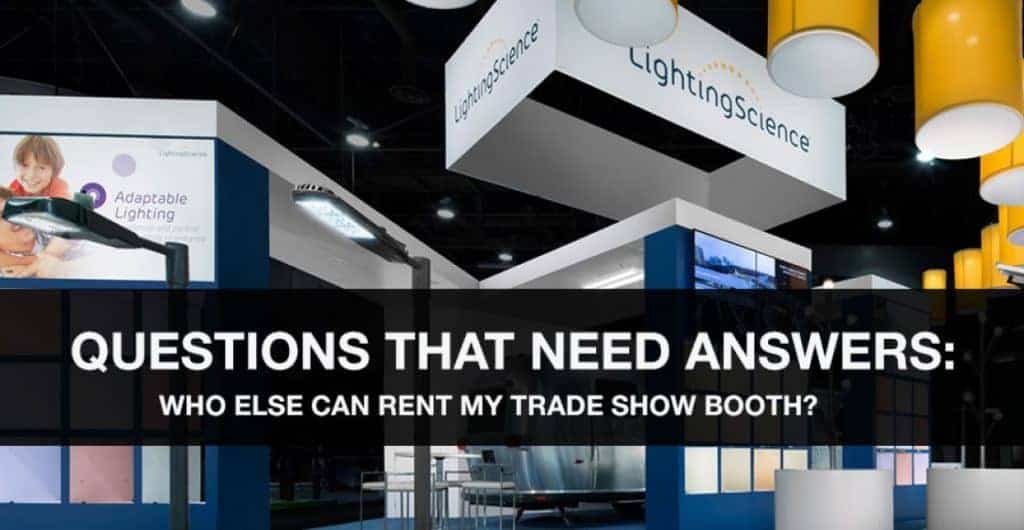
In the last article of our series, related to “the questions you should ask of your trade show rental partner prior to signing the contract” – we’ll tackle the burning question:
Can other exhibitors rent the same trade show booth as my company?
Of course there are sooooo many reasons why you wouldn’t want your competitors to rent your exhibit out from under you or, for that matter, to have the same exhibit that you do. That goes without saying!
But What About Non-Competing Firms?
It’s important when researching trade show rental firms to be clear on their positioning, when it comes to whether or not other companies can rent the same booth as you. In other words, will your exhibit provider rent your components to other companies when you’re not using them??
Some firms consider this practice a no-no, while others feel it’s right to rent their trade show booths as many times as possible.
Simply, know where your trade show rental provider stands on the topic and, more importantly, whether this stance is something YOU can live with!
How Does This Affect the Availability of Your Trade Show Booth?
Another important question to clarify deals with the availability of your rental trade show booth. If your trade show rental provider is renting properties you use to other exhibitors, how far in advance will you need to reserve your components?
And just as important – what happens if a new show pops up on your calendar and your typical rental properties are being used by another exhibitor? Where does that leave your company?
These may seem like obvious questions to ask, but without knowing the answers in advance – you could find your company in a position where you’re without your preferred exhibit for an important show. It’s always easier to ask the right questions ahead of time, rather than pay the price later.
If you’d like our team of trade show rental professionals to help clear up these and many other concerns you might have about your trade show rental program – hit us up! We’d love to show you the benefits of a trade show rental program and help you avoid the challenges that can arise!

- Blog Post
My company is planning to rent, rather than buy, our next booth. So as I hunt for rental-exhibit providers, what questions should I ask them before signing a long-term agreement?
Compared to purchasing a new exhibit, renting seems like a short-term commitment with minor risks and a minimal upfront investment. And as such, many exhibitors rush into a long-term rental contract without fully investigating the high points and pitfalls of each agreement and provider. In reality, renting requires just as much forethought, analysis, and comparison as purchasing, regarding everything from fees and terms to supplier selection and contract obligations. Indeed, exhibit rental is a wonderful choice for many marketers, but it’s not something you should charge into blindly just because it seems to involve less risk and a smaller initial cash outlay than a purchase.
So to ensure you’re not flying blind, here are five key questions to ask potential exhibit-rental providers. While certainly not the end-all-be-all of supplier-search topics, the following queries cover key sticking points in the exhibit-rental process.
1. What materials, structures, and ancillary elements are available?
While this seems like an elementary question, exhibitors often make assumptions about what rental providers are willing or able to offer, and then they’re shocked when the supplier is unable to deliver. So talk to your exhibit-rental provider about both its offerings and its limitations.
For example, will your exhibit design comprise only those structural elements the firm has in stock, or is it willing to build or purchase new elements to suit your needs? Is it prepared to mix and match any existing elements you have with its rental inventory to create a hybrid design, and if so, will it refurbish existing pieces to effectively blend with the rental components? Does the firm use a specific exhibit system that’s difficult to integrate with custom components or other systems?
And what material options are available? For example, does the provider carry a wide selection of tensioned-fabric frame shapes and materials? Does it offer variations in finishes, unlimited color palettes, etc.? If an exhibit component or material isn’t in stock, will the firm seek it out for you, and how much will this search and acquisition cost? Plus, aside from the exhibit structure, what rental components does the provider offer, and what will you have to purchase or rent elsewhere? Inquire about everything from audiovisual equipment and multimedia units to lighting and sound systems. Knowing exactly what each rental firm can and can’t provide will help you select the right partner to fit your current and future needs.
2. How are long-term discounts structured into the agreement, and is there an option to purchase?
A long-term rental contract should include some sort of multiple-rental price break. But be sure you understand how your pricing and discounts are structured into the contract and what kind of variables are allowed under your agreement. For example, if you rent the exact same exhibit for five shows and rent a completely different booth for your sixth show, does your discount or pricing change?
Also determine if your discount is front- or back-loaded, or distributed evenly. For example, will you pay $10,000 for your first rental, $8,000 for your second, and so on? Or will you get the same discounted price (e.g., $5,000) for all rentals as long as you rent at least five times during your contract period? Surely, do the math to determine if the pricing structure makes sense for your budget. But also consider the ramifications of severing the contract early. If, for example, your pricing discount requires a minimum number of rentals and you want out of the contract after two, how much will you be penalized?
Along these same lines, inquire about contract-termination clauses. What if your exhibit program changes considerably during the contract period and you need to switch rental structures, discard a custom rental property, or change to a purchased exhibit altogether? And what about rent-to-own options? What if you fall in love with your rental and want to purchase it? Can any of your rental costs be applied to a purchase? Talk through all of these scenarios and more to determine whether your rental contract is flexible or ironclad.
3. What additional fees are involved?
Just as with a purchased exhibit, there are myriad ancillary fees associated with rental exhibits. So ask your provider what costs are included in your contract and what will come out of your pocket later. For example, will you be charged extra to store your exhibit? And if so, how will those fees be calculated if you don’t use the same exact properties at every show (and therefore, don’t require the same amount of storage space during the contract period)?
And who pays for refurbishments? With a short-term rental, the exhibit provider is typically responsible for refurbishment costs. But what if you have a custom rental? Or what happens if a piece of exhibitry is lost in transit or stolen? It’s always better to discuss what-if scenarios prior to signing on the dotted line – and to alter or walk away from a contract that isn’t in your best interest.
4. What additional services are required to manage and/or display the exhibit property?
Determine whether you or your provider will make arrangements for services such as transportation, installation and dismantle, drayage, etc. If the provider is responsible for these services and they’re not part of your rental agreement, how much will they cost, and how much will your supplier mark up each service?
Also inquire as to whether you’re required to use the rental provider or its preferred vendors for services. Many rental firms will only allow their laborers or other firms with which they have experience (and perhaps financial agreements) to handle their properties. This may be financially beneficial to the exhibitor, but it also eliminates your freedom of choice and could force you to sever long-term relationships with your preferred service providers.
5. Can other exhibitors rent the same properties we plan to use?
There are countless reasons why you wouldn’t want competitors to rent your booth out from under you. But what about non-competing firms? Will your exhibit provider rent your components to other companies when they’re not in use? Some firms consider this a no-no, and others feel it’s within their rights to rent their properties as many times as possible. Know where your provider stands on this topic and whether this stance is something you can live with.
Similarly, if your provider is renting properties you use to other exhibitors, determine how far in advance you will need to reserve your components. What happens if a new show pops up on your calendar and your typical rental properties are being used by another exhibitor?
Clearly, these questions are just the tip of the iceberg when it comes to long-term rental agreements and providers. However, these five queries should help narrow your provider search and hopefully prompt further queries to deepen your analysis. Contact ColorCraft today to discuss your next rental exhibit.



Ready to build your next. show.
Tell us about your next event — booth size, show dates, and what you’re trying to get across the floor. A partner will follow up directly.