- Home
- /
- Blog
Blog
Ideas in action.
Strategies, ideas, news, and inspiration from the ColorCraft team — on building exhibits that engage audiences and deliver measurable results.
- Design · Engineering · Fabrication · Install & Dismantle
- Orlando · Las Vegas · Dallas
- Blog Post
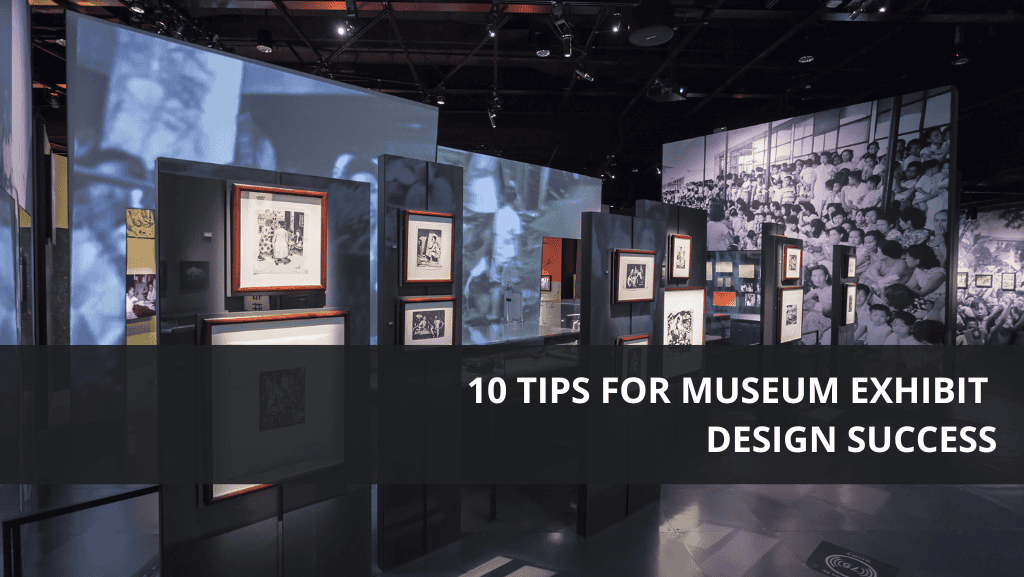
If you’re trying to design a permanent or temporary museum exhibit, you already know that they make the perfect outing. With a successful museum exhibit, you can provide individuals and families with a unique way to learn and experience history, inspiration, art, and wonder. But it raises the question – how do you create great museum exhibit design?
Successful museum exhibit design enhances the experience your visitors receive and the learning or entertainment value they take from it. No matter what you’re exhibiting, we have some suggestions that can help any museum create a winning display. Here are our top 10 tips for designing a great museum experience:
1. Have “Visitor Personas” and a Clear Audience in Mind
Before you can start designing a successful museum exhibit, you should aim to understand who your target visitors are and what they want from the experience. Creating and targeting specific customer personas is a great way to achieve that. If you’re part of an already established museum, you can start by evaluating the demographics of your existing customers. If you’re building a new or temporary installation, you can start by looking at the demographics of your surrounding area. Either way, you can start to create “visitor personas” based on the data and who you think your subject matter will most interest and attract. As you start planning, you’ll want to tailor your museum exhibit design towards those personas.
2. Tell a Story (and Stories Within the Story!)
There is no better way to make your visitors feel like they are a part of art or history or fully immersed than through the art of museum exhibit storytelling. At first, you might be tempted to focus on only one broad story per each one of your exhibits. But don’t think of signs as only being able to identify and date the artifacts. While that’s an important component to successful museum exhibit design, it’s missing one key element – the stories within the story. You can use signage to also tell specific, detailed stories about the pieces that fit within the larger framework of your display. That serves as an interesting way to further immerse and educate your visitors. As humans, it’s the stories behind historical artifacts and grand paintings that help us feel connected to them. You can use signs, banners, interactive kiosks, and technology all throughout your museum exhibit to tell those mini-stories.
3. Create a Linear Flow Through the Museum Exhibit
Just as most stories are best told in a linear, chronological manner, so are museum exhibits. You want to design the experience to “walk” visitors through history. It’s important to create a sense of time and place in every part of the display. This is especially true when creating an exhibit about history, inventions, or evolution of the natural world. But you can do more than arrange the display along a timeline. For compelling museum exhibit design, use exhibit graphics, labels, signage, sounds, and interactive technology as visual cues. These can help you completely immerse your visitors in different time periods.
4. Use Graphic Design to Create Interest, Flow and Focus
The use of graphic design is vital to bring your museum exhibit to life. That can mean anything from signs and labels to banners and huge set pieces. On a basic level, signs and graphics can help organize the flow of traffic. They’re also one of the best tools for turning your museum exhibit into a themed environment. Instead of placing your visitors in the role of casual observers, you can immerse them in the experience. With the right environment, they’ll feel like active participants in history. The Kennedy Space Center exhibits are a great example, and how they make people feel like astronauts on the International Space Station.

5. Incorporate Interactive Learning With Gamification
Try leveraging the latest techniques from the gaming industry to create fun and interactive experiences for the kids. You’ll end up creating an experience the entire family can enjoy.The best part is that gamification can be incorporated into a museum exhibit design on any budget. You can consider low-tech options like incorporating a hidden “treasure hunt.” This involves hidden items into your visuals and graphics that families can walk through and find together. Or you can go high-tech, with clickable, interactive games on kiosks and digital displays. You can even consider the latest in AR (augmented reality). Whichever way you go, you can “gamify” the experience to help kids connect to and learn from your museum exhibit.
6. Embrace Technology in Your Museum Exhibit Design
We just mentioned the exciting possibilities that gaming tech offers. That’s just one part of all the great tech you can use. Integrating technology into your museum exhibit design can help capture and hold the attention of your visitors. Technology to consider might range from interactive kiosks to video monitors, but it can even go beyond your physical display. Audio and mobile apps are an innovative way for your visitors, especially the younger ones, to learn from and interact with your museum exhibit.

7. Present Art and Artifacts in Interesting Ways
When it comes to displaying the artwork or artifacts at the heart of your museum exhibit, you can apply our same tips for innovative product displays. First and foremost, make sure the items are easily visible. For small artifacts, you can bring them into view with the usual good lighting and elevated platforms. You can also add large graphics, hanging banners, or video screens next to them. With larger artifacts, it can be striking to counter expectations that they’ll be on the ground or a low platform. Instead, you can mount them to the wall or structure of your exhibit for a fresh perspective. The key is to make sure your display isn’t crowded so that each artwork or artifact can make an impact.
8. Divide Larger Exhibits into Sections
When it comes down to it, sometimes the easiest way to tell your story, create a linear flow, and build striking artifact displays is to break a larger exhibit into smaller sections. This can help make the information more digestible for your museum visitors. It also allows them to get a sense of completion as they move from section to section. Adopting this approach will allow you to get creative with your use of the walls and layout in your museum exhibit design. You can employ effective and dramatic storytelling through your choice of when to unveil different artifacts and information to people as they move through the exhibit.
9. Use Consumer-Centric Marketing to Generate Buzz
It doesn’t matter if you’re designing a small local display focused on the nearby community or a larger exhibit that relies on drawing visitors and tourists from afar. There has to be a buzz created around the museum exhibit to ensure steady foot traffic. When doing any museum marketing, you can create buzz by putting yourself into your customer’s perspective. First, figure out the main focal points of the display that will attract their interest. Then make sure you and your team talk those features up in your local press, community calendars, digital marketing (website, social media, and email campaigns), printed brochures, and more.
10. Design With Clearly Defined Goals as Your Road Map
We’ve talked about the different experiences your exhibit can offer your visitors, and the different elements you can incorporate. There’s one final step before you start designing. You have to decide what you want to achieve with your museum exhibit design. Are you trying to educate, entertain, or inspire? Do you want to make it fun for the family, or strike a serious note? You’ll be faced with so many decisions during the planning, design, and implementation. You should have clearly defined goals that you can fall back on. You can later use them to measure your museum design success as you build out the perfect experience for your visitors.
- Blog Post
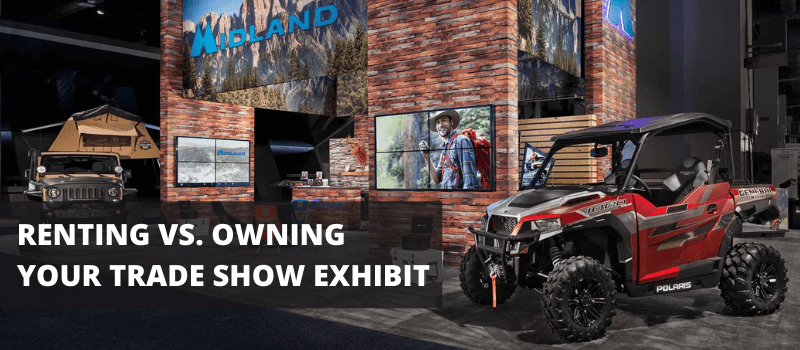
By now, most trade show marketers understand the availability of both trade show exhibits you own and those you rent. But what are the pros and cons of renting vs. purchasing your company’s trade show exhibit(s)?
To start, let’s just say that it really depends on your company’s needs. Do you only exhibit at one or two shows per year? Does your company exhibit at multiple shows per year, with some shows happening at the same time? And do you want or need flexibility in the size, look and feel of your exhibit from show to show?
Answering these and a few other questions will help to quickly determine if renting or owning is the best option for your trade show program – and hopefully, our list of pros and cons can help you make the most of your decision.
Trade Show Exhibit Rental – Pros
Capital Expenses and the Tax Man – Because rental exhibits are just that, rentals, there is nothing to actually buy. This helps to minimize the administration and processing of a large capital expense.
No Shipping & Storage Feeds – Owning your trade show exhibit comes with some baggage – storage and shipping to name two. A major “pro” to renting your trade show booth is that once your show is over, the booth is not yours to ship nor store. Both of which save time, money, and hassle.
Maintenance and Repair Costs are Minimum – Again, because you don’t own your rental exhibit, the cost of routine maintenance and repairs from “wear and tear” are minimal to non-existent. Over time, especially during setup, tear-down, and shipping – trade show booths sustain damage. When you rent, this is typically not your responsibility.
Custom Exhibit at a Lower Cost – Because with rental trade show exhibits you are not purchasing the structure of your booth (nor paying for storage or repairs), you should have more budget to put towards customizing your exhibit with brand graphics or larger floor space and footprint.
Look Different From Show to Show – In a world where first impressions are everything, updating your look from show to show can be important. Renting your trade show exhibit gives you the flexibility to evolve your entire exhibit structure and design from show to show – including its size and footprint.
Trade Show Exhibit Rental – Cons
Costs Can Be Higher Over Time – Especially if your company exhibits at several shows per year (year after year), renting your trade show booth could cost you more money than owning (over time).
Rental Exhibits Can Show Wear – Depending on the outfit from which you rent your trade show exhibit, some rentals may show visible wear-and-tear from previous use, shipping and setup. Shop wisely.
Availability – As you do not own your rental, availability can become an issue if you don’t plan ahead. Again, be certain to choose a vendor that can meet your needs and reserve your exhibits as early as possible.
Furniture and Accessory Costs – If you will not be owning your furniture, costs for these components can be quite high and again, availability can be a concern.
Trade Show Exhibit Ownership – Pros
Cost Over the Long Term – If you exhibit at a number of shows per year and are a very active trade show marketer, the cost of owning your custom trade show exhibit will very likely be less than renting.
Total Control Over Every Detail – Because this is your booth, you can have it spec’d and built exactly the way you’d like it AND have complete control over the choice of materials and finishes used.
Your Brand – And of course owning your trade show exhibit gives you complete control over how your brand is represented – from the exhibit’s footprint to the materials and graphics that greet attendees!
Trade Show Exhibit Ownership – Cons
Initial Expense – The initial cost of building and owning your trade show exhibit won’t be cheap. With rentals, there is no initial investment.
Lack of Flexibility – Your business and offerings change and so do market and design trends. When you own your trade show exhibit, updating your look and feel – especially from one show to the next can be either quite costly or in cases totally prohibitive.
Responsibility for Storage, Shipping & Repairs – When you own your trade show exhibit, you’ll have some added responsibility over renting. To name a few – the costs of storing your exhibit between shows, shipping logistics and cost, and of course, repairs and maintenance. These must be factored into the equation when choosing between renting and owning.
Additional Considerations in Renting vs Owning Your Exhibit
The Number of Trade Shows You Exhibit at Each Year
If your company only exhibits at a few shows each year, then renting your trade show booth is most likely a more cost effective option than purchasing. With the cost of renting an exhibit being about 1/3 the cost of purchasing, along with not incurring the costs of storage and insurance, you can fairly easily exhibit at 3-4 shows and still be saving money by renting vs purchasing.
However, if your company exhibits at a number of shows per year (5+), then purchasing your exhibit might be the most viable solution. Just keep in mind that the purchase of your exhibit comes with additional costs such as storage, insurance and eventual refurbishment or replacement.
You Are a New Business or Wish to Test Different Booth Designs
New businesses are often operating under tight marketing budgets and just as often only have the need to attend a few shows for the first few years in business. That being said, saving money by renting not only gets you to the show floor by spending less on your exhibit structure, but also frees up additional budget to apply to your trade show graphics, marketing collateral and giveaways.
Additionally, if your business is new and hasn’t exhibited before (or only at a few shows) – renting your trade show booth gives you the flexibility to test the waters with different configurations, graphics and designs. Once you’ve found a recipe for success, you can consider the purchase of an exhibit of the successful design. Kind of like A-B testing for the show floor. Cool.
You Company Needs to Exhibit at Multiple Shows – at the Same Time
Whether or not you currently own a trade show exhibit, there may be times when your company needs to be represented at more than one show at once – possibly in more than one country at the same time. Renting a secondary exhibit or renting more than one exhibit becomes a valuable solution in this scenario.
Your company may use their purchased exhibit at one show, and the rental at a different show, possibly overseas. Not only will you be saving by not purchasing multiple booths (which could be an absolute deal breaker) but you might also be able to avoid the costly price of shipping & logistics of getting your “owned” exhibit property overseas.
Upgrading and Changing the Design/Configuration of Your Exhibit
There comes a time in the life of every trade show booth or exhibit when it is in either need of refurbishment or your company has outgrown it all together. For most exhibits, this is typically around the three-year mark (depending on how often it’s been used and how nice you’ve been to it).
At that time, if you own your trade show exhibit you’ll be faced with the decision of whether it makes the most sense to refurbish your existing booth OR let it go and start fresh.
Another thing to consider is that over time (especially if your business is growing or your products lines shifting) you may simply outgrow your current trade show booth.
In either of these scenarios, the number of shows you attend over the life of your exhibit will strongly dictate whether purchasing or renting is the best choice. But, you should consider that while renting, you’re never faced with refurbishment or an aging booth AND you can literally have a different sized booth at each show you participate at! You’re never tied to a single structure for more than your next show!
We hope our list of “pros and cons” helps you make the best choice for your trade show marketing program, but if you’re still unsure of what’s right for your company – give us a shout.
The seasoned team of professionals at ColorCraft will help you make the best choice for your business!
- Blog Post
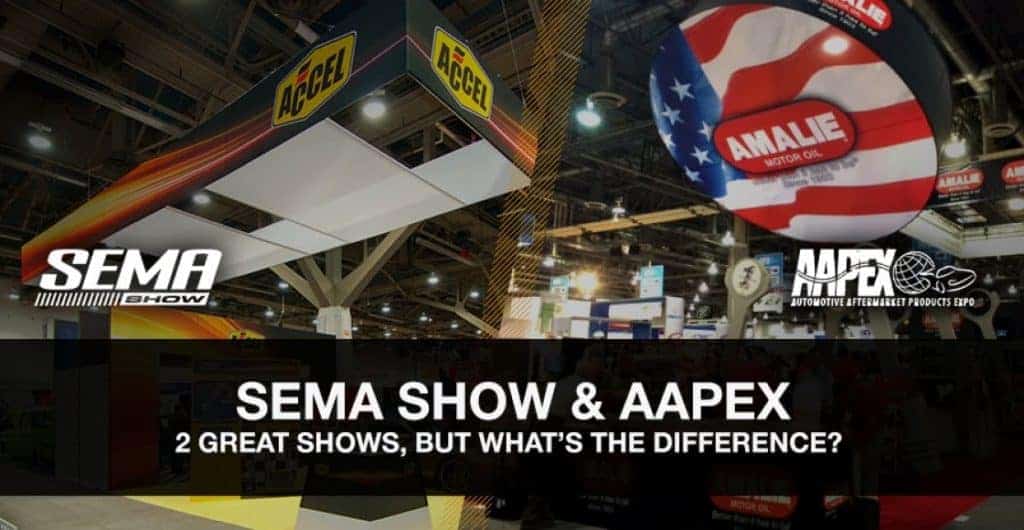
No doubt, Automotive Aftermarket Industry Week, in November of each year is one of the biggest trade show weeks of the year for Las Vegas. Every November, Vegas hosts both the SEMA Show (Specialty Equipment Market Association) and the somewhat lesser-known AAPEX Show (Automotive Aftermarket Products Expo) in conjunction with one another.
Together, these two shows bring well over 100,000 industry professionals and 60,000 domestic and international buyers together – for one great week of automotive excellence.
But, back to the title of this article – what’s the difference between the SEMA & AAPEX Shows??
SEMA Show – Specialty Equipment Market Association
According to the SEMA website, this show is targeted to be the “premier automotive specialty products trade event in the world”. And based on their latest statistics the show draws more than 100,000 industry leaders from the automotive, truck, SUV, Powersports, and RV markets.
While not open to the general public, SEMA focuses on performance products, accessories, and add-ons – as well as related services for the automotive market. In addition, SEMA Show provides educational seminars, product demos, and other special events and networking opportunities.
So, think of SEMA Show as THE place to showcase and see the latest in performance items, add-ons, new parts, tools, and components.
AAPEX – Automotive Aftermarket Products Expo
While a bit smaller than the SEMA Show, AAPEX Show is also part of Automotive Aftermarket Industry Week. As the AAPEX website touts – this show is where “those who shape the future of the automotive aftermarket will gather”. Attendance for the AAPEX Show includes over 39,000 buyers and more than 130,000 domestic and international industry professionals.
The AAPEX Show focuses on original equipment and products to service vehicles. Not quite as flashy as SEMA Show, but for the automotive and supporting industries, this show is just as important.
The types of products that might be found at the AAPEX Show include tools, automotive oil, air conditioning components, and other service-oriented products. In addition, AAPEX Show also provides a number of learning and networking opportunities.
So, Which Show Do You Attend?
Each show attracts a slightly different demographic, but it’s worth spending a bit of time at both shows. You’ll most likely dedicate a bit more time to the larger SEMA Show – but AAPEX is again, just as important.
Thinking of exhibiting at SEMA Show or AAPEX? ColorCraft has a number of clients at both shows each year – so we know the territory. Give us a shout and we’ll help make sure your Automotive Aftermarket Industry Week is a SUCCESS!
Ready to build your next. show.
Tell us about your next event — booth size, show dates, and what you’re trying to get across the floor. A partner will follow up directly.